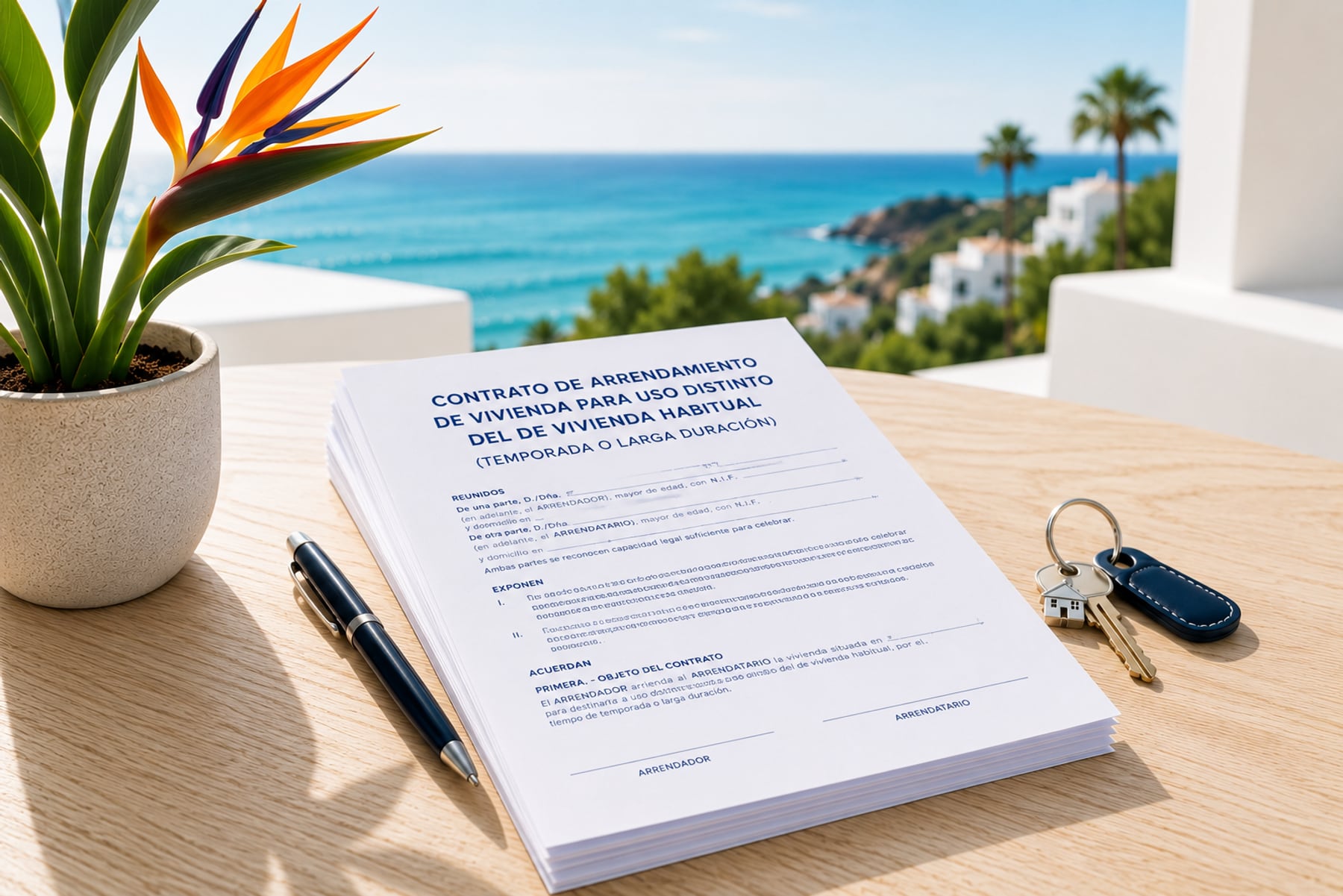
The Spanish rental contract, the file and the law — in one system.
You enter the details once. ContractHost determines the regime, draws up the Spanish signing contract with the bilingual reading version beside it, fills every annex, keeps the file per client and warns you the moment the law changes. Residential lets and temporada.
Three layers you now maintain yourself
The contract engine
Not a template with holes in it, but an engine that first determines which contract this has to be and only then writes it.
- Residential tenancy (LAU art. 2) and temporada (art. 3.2), as a Spanish signing contract
- A bilingual reading version in which every clause is explained in your client's language
- Fillable annexes: inventory, handover, meter readings, house rules, checklist and, for temporada, the proof of main residence
- The deposit rules of every region with the competent body, deadline and sanction, determined by postcode
- A reference number with consultation date on every document
The file layer
The contract is day one. The rest of the term lives here, per client, instead of in your diary and your head.
- Archive per client, recording which model version and clauses were used
- Payment schedule with mark-paid and recibos as receipts
- Automatic rent reminders in seven languages, which stop the moment payment comes in
- Inventory with check-in and check-out photographs and signature
- Deposit return: what was withheld, why, and with what evidence
The law monitor
The piece of work nobody bills for and that still has to be done every year. We do it; you get the notice.
- Revised models and a notice as soon as the law changes
- Deadline monitoring on the deposit lodging deadline — the deadline that differs per region and carries the sanction
- Deadline monitoring on the approaching end of contract, well before automatic extension kicks in
- When a rule changes you simply generate the contract again — at no extra cost
This is what changed in eighteen months
Every one of these changes touches the wording of a rental contract, the deposit rules, or both. Anyone working from their own template has to spot them and implement them. That is exactly the work you outsource here.
-
1 January 2026
Catalonia tightens the rules through Llei 11/2025
In stressed zones, temporada lets fall under the rent cap, and the temporary purpose of the stay must be documented with INCASÒL. A temporada contract without a substantiated purpose has been a different product in Catalonia ever since.
Llei 11/2025 (Catalunya) · in force 1 January 2026 -
24 January 2026
Andalucía abolishes deposit lodging with AVRA
The obligation to lodge the fianza with the regional body has lapsed. The deposit itself remains fully mandatory — a distinction that is regularly confused in practice and that an outdated clause exposes immediately.
Ley 5/2025 (Andalucía) · in force 24 January 2026 -
24 February 2026
The Constitutional Court upholds Ley 12/2023
With STC 17/2026 the Tribunal Constitucional again dismissed a challenge to the housing act; the count now stands at six judgments. The tenancy law these contracts rest on is therefore not in motion but firmly confirmed — good news, but only if your template is built on it.
STC 17/2026 · Tribunal Constitucional -
21 May 2026
The Supreme Court partially annuls the NRUA
With STS 620/2026 the Tribunal Supremo declared parts of the Registro Único de Arrendamientos void. Anyone who had built their templates or their client guidance on it was wrong the next morning. Our corpus was rewritten that same week.
STS 620/2026 · Tribunal Supremo, 21 May 2026 -
Early September 2026
Housing decree expected in the BOE
An announced decree is expected in the Boletín Oficial del Estado in early September. We track the publication and the ratification period; if anything changes in the models, that notice goes out the same week.
Announced — not law yet
You do not have to keep track of this. We follow the consolidated statutory text, the BOE and the regional bulletins, adjust the models and send you a notice with what changes and what it means for running files. You generate the contract again, at no extra cost.
Annual billing is ten months instead of twelve. Monthly stays cancellable monthly.
Office Start
excl. VAT · cancel monthly · annual billing = 10 months
- Up to 10 files under management
- €2.90 per file per month
- 1 user
- White label from Office S
- Everything in the base above
Office S
excl. VAT · cancel monthly · annual billing = 10 months
- Up to 30 files under management
- €2.60 per file per month
- 1 user
- Your office name on the document — contract, reading version and annexes
- Everything in the base above
Office M
excl. VAT · cancel monthly · annual billing = 10 months
- Up to 100 files under management
- €1.99 per file per month
- 3 users, each with their own login
- Your office name on the document
- Everything in the base above
Office L
excl. VAT · cancel monthly · annual billing = 10 months
- Unlimited files under management
- Indicative: 101–250 files €399 · 251–500 €599 · above that bespoke
- Unlimited users
- Your office name on the document
- Everything in the base, plus priority when the law changes
The contract card — 5 files, one-off
For offices that draw up a handful of contracts a year and do not want a monthly commitment. You buy five files, use them whenever you like, and nothing renews. No cancellation needed, because there is nothing to cancel.
- Five files, each with unlimited contracts — a typo or a new tenant never costs you a credit
- Valid for twenty-four months, so you can spread them over two seasons
- Includes the signing contract, the reading version and every annex — the same documents as the subscriptions
- Without white label, shared access or deadline monitoring
Doing more than five a year? Office Start is cheaper: €29 a month for ten files.
€29.80 per file
You receive the activation code by e-mail, usually within one working day.
Not a fill-in-the-blanks template, but a legal engine
A template is a document with holes in it: whatever you fill in is your responsibility. ContractHost works the other way round. It asks the questions a lawyer would ask — what is the purpose of the stay, where is the property, who is the landlord — and uses the answers to determine which regime applies, which clauses belong in the contract and which ones must not be there. Every clause carries its legal basis and the date on which we verified it. When the law changes, the engine changes — and you generate the contract afresh.
For an office, that is the difference between “we use a good model” and “every statement in this file is traceable” — exactly what you need when a client, a counterparty or a judge asks questions about it years later.
This sample shows two of the dozens of decisions taken for every file. In the real file, every outcome is written out in full, completed with your client's details, and carries its legal basis and reference date.
What is “your office name on the document” (white label)?
From Office S upwards, the contract and the bilingual instruction document carry the name of your office in the document footer, instead of ours. Your client sees your office as the sender of a legally polished file; the content, the source reference for every clause and the reference date remain identical — which is precisely what you rely on when a client asks questions later. You deliver the bespoke feel of a law firm, at the running cost of a subscription.
Why you can put this in front of your client
No badges and no customer counts — these are the things you can check yourself.
- Every clause carries its statutory article and consultation date. Not in a colophon at the back, but per clause: which article, which consolidated text, and on what date we consulted it. You can verify every line yourself in the BOE.
- Reviewed by a lawyer admitted in Spain. Every change with legal impact — a new clause, an amended deposit rule, a shift in case law — is assessed before go-live by an abogado colegiado.
- A reference number with consultation date on every document. Years later you can still show which state of the law a contract rested on — the difference between “it was fine at the time” and being able to prove it.
- We run the consumer shops ourselves. The same engine supplies the contracts on spanishrentalcontract.com and huurcontractspanje.nl. We are not selling you a system we do not use ourselves every day.
- No text from a language model. Every contract is assembled from a fixed clause register written by people and maintained against the consolidated statutory text. When the law changes, the system blocks issuance until the model has been updated.
Carry on doing it yourself, this system, or a lawyer per case
All three work. The difference lies in how much you have to work out yourself, what it costs per file and what happens when something changes.
| Doing it yourself | ContractHost. | A lawyer per case | |
|---|---|---|---|
| Cost per file | Your own time: 2 to 3 hours | €1.99 to €2.90 a month | €200 to €400 per contract |
| Turnaround | Half an afternoon | 10 to 15 minutes | Days to weeks |
| Right regime: residential or temporada | You decide, case by case | Determined from your answers, with legal basis | Yes, that is their job |
| Bilingual reading version per clause | No, or you translate it yourself | Yes, in your client's language | Verbally, at an hourly rate |
| Annexes: inventory, handover, meter readings, checklists | Gathered separately | Yes, digitally fillable | Usually not included |
| Regional deposit rules | Looked up yourself, per region | By postcode, with body, deadline and sanction | Yes |
| Proof of main residence for temporada | Drafted yourself | Yes, separate annex | On request |
| New version when the law changes | You have to spot it yourself | Notice and revised model, at no extra cost | New contract, new invoice |
| File, payment schedule, recibos, reminders | Your own folder and diary | Built in, per client | No |
| Your office name on the document | Yes | Yes, from Office S | No, theirs |
| Assessment of your client's situation | You do that yourself | No — we deliberately do not | Yes, that is their job |
Is this inferior to a contract from a lawyer?
As a document, no. What your client signs is a full Spanish rental contract under the same law — assembled from clauses each checked individually against the consolidated statutory text, with the article and the consultation date attached. On several points you get more than from an average instruction to a firm: the bilingual reading version explaining every clause, the fillable annexes, the deposit rules of the region concerned with body and deadline, and a reference number that lets you show years later which state of the law the contract rested on. A lawyer or gestoría usually delivers the contract, in Spanish, without that explanation and without those annexes.
Where a lawyer does do something we do not: assess the situation. We give no legal advice and do not look at your client's circumstances. If there is a live dispute, an unusual structure or a large financial interest, that needs a human being — and this file is still a good starting point to put in front of them, with the articles alongside.
Order now
No sales call. You order, we activate within one working day and you receive the invoice by e-mail.
Frequently asked questions
Are the prices per month or per year?
How does VAT work?
Which contracts are included?
What does the file archive involve?
In which languages does my client receive the documents?
Does ContractHost give legal advice?
What happens if the law changes during a running contract?
Letting out one or two properties of your own? Then this is not your page. ContractHost is for offices drawing up contracts on behalf of third parties; as a private landlord you buy the same contract one at a time in our own shop spanishrentalcontract.com — the same shop cited as evidence above, and therefore the same engine.
Questions? E-mail [email protected] — you will get an answer from a person, not a sales funnel.